
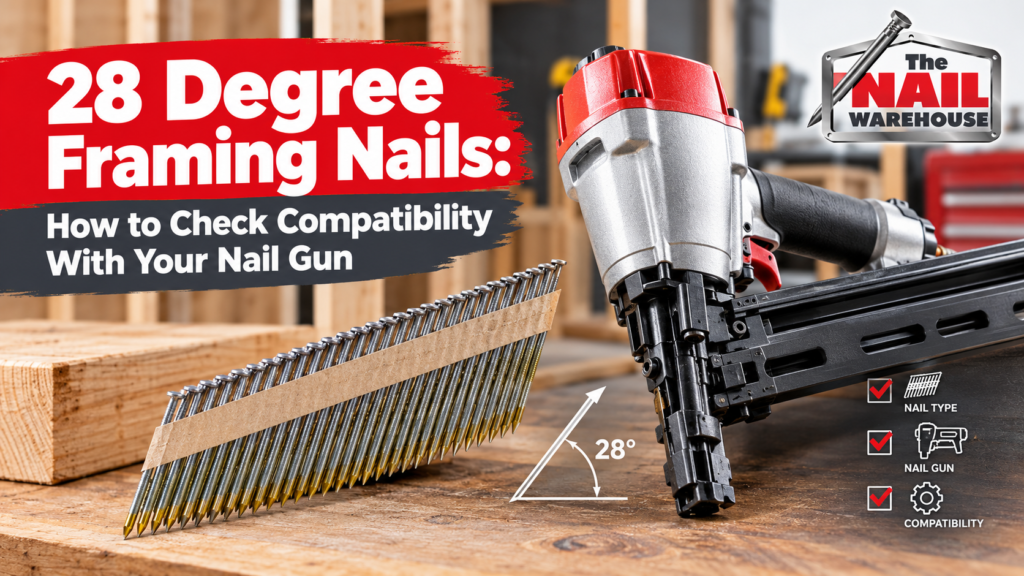
Choosing 28 degree framing nails involves more than matching the angle printed on the carton. The Nail Warehouse lists framing nail options, but the complete fastener specification must suit both your nail gun and the fixing requirements of the job.
Nail length, shank diameter, head shape and collation type can affect compatibility. Two products described as 28 degree framing nails may not be interchangeable in every tool.
This guide from The Nail Warehouse explains what to check in your nailer manual, how to compare product specifications and which details to confirm before ordering.
What Are 28 Degree Framing Nails?
28 degree framing nails are collated fasteners supplied in angled strips for compatible framing nailers.
The angle describes the arrangement of the collated strip. It does not identify every feature needed to establish tool compatibility.
Specifications to Check Include
- Collation angle.
• Collation material.
• Nail length.
• Shank diameter.
• Head shape and dimensions.
• Shank profile.
• Point type.
• Material and finish.
• Fastener series or product code.
• Manufacturer-approved tool compatibility.
The Nail Warehouse lists 28° framing nails in 50mm, 75mm and 90mm sizes. Confirm the complete specification for the particular product before purchasing. The Nail Warehouse
1. Identify Your Exact Nail Gun Model
Start with the tool rather than the nail carton.
Different framing nailers from the same brand can accept different fastener systems. A general description such as “framing gun” does not establish which nails it uses.
Tool Details to Record
- Manufacturer.
• Full model number.
• Model suffix or regional version.
• Fastener information on the tool label.
• Magazine identification, where relevant.
• Any approved conversion or replacement components.
• Operating manual reference.
Photograph the tool’s identification plate if you are asking a supplier to help check compatibility.
For an older or second-hand nailer, obtain the correct manual before ordering fasteners.
2. Check the Manufacturer’s Fastener Specification
The tool manual should be the starting point for identifying accepted fasteners.
Look for a fastener specification table, approved nail series or compatible product references.
Information to Find
- Permitted collation angle.
• Accepted collation type.
• Minimum and maximum nail length.
• Permitted shank diameters.
• Accepted head configuration.
• Relevant fastener series.
• Loading instructions.
• Operating restrictions.
For example, Bostitch describes its F28WW as a 28° wire-weld framing nailer accepting nails up to 90mm. This is a model-specific description, not a specification for every 28 degree nailer. bostitchtools.com.au
Compare the complete specification rather than relying on a shared angle.
3. Match the Collation Angle
The angle of the nail strip must match the tool’s approved fastener arrangement.
Do not assume that nails with a similar-looking angle will feed correctly.
Questions to Ask
Does the manual specify 28 degree nails?
• Does the product identify its angle clearly?
• Is the fastener series approved for this tool?
• Are there model-specific restrictions?
• Has the manufacturer confirmed any alternative fasteners?
The Nail Warehouse lists 28° and 34° framing nails as separate products. Their similar available lengths do not make them interchangeable. The Nail Warehouse
Do not bend strips or modify the magazine to accommodate an unapproved angle.
4. Confirm the Collation Material
Collation is the material or arrangement holding the nails together.
An angle alone does not establish whether a product uses the collation system your nailer requires.
Collation Details to Confirm
- Wire-weld or paper collation.
• Manufacturer’s fastener series.
• Strip configuration.
• Nail spacing.
• Compatibility with the magazine and feed system.
• Any restrictions in the tool manual.
Bostitch’s F28WW-E product information specifies wire-collated nails. This illustrates why collation type needs to be checked separately from the 28° angle. bostitch.co.uk
If a product description and tool specification appear inconsistent, request clarification before loading the nails.
5. Check the Accepted Nail Length
The nail must fall within the length range permitted for the exact tool.
A nailer accepting one length of 28 degree nail may not accept every length available in that product range.
Length Checks to Complete
• Minimum permitted nail length.
• Maximum permitted nail length.
• Length of the selected product.
• Any required magazine adjustment.
• Application-specific length requirements.
For example, a 90mm nail should not be used in a tool whose documented maximum length is 83mm.
Also check whether the selected length provides the penetration required by the job. Tool compatibility and connection suitability are separate decisions.
6. Compare Shank Diameter Carefully
Nails of equal length can have different shank diameters.
A diameter outside the tool’s specification may cause feeding or driving problems.
Details to Review
- Product shank diameter.
• Tool’s permitted diameter range.
• Units used in the specification.
• Approved fastener series.
• Diameter required by the fixing schedule.
Bostitch’s F28WW-E specification sheet lists a diameter range of 2.8–3.3mm. That range applies to the identified model and should not be transferred to another nailer without checking. bostitch.co.uk
Avoid treating nearby metric and imperial sizes as automatically equivalent. Use the manufacturer’s documented size or approved product reference.
7. Verify Head Shape and Dimensions
The nail head interacts with the magazine, driver and finished connection.
Matching the angle, length and diameter is insufficient if the head arrangement is unsuitable.
Head Details to Confirm
- Head shape.
• Head diameter.
• Head thickness, where specified.
• Position relative to the shank.
• Approved fastener series.
• Requirements of the connection.
Descriptions such as clipped head, D-head, offset round head and full round head should be checked against the exact product and tool documentation.
Do not assume that all nails marketed for framing have the same head configuration.
8. Review Shank Type, Finish and Application
A fastener may suit the tool but still be inappropriate for the work.
The shank profile and corrosion protection should match the specified connection and installation environment.
Application Factors Include
- Timber species and density.
• Timber treatment.
• Required holding performance.
• Nail length and penetration.
• Head requirements.
• Indoor or outdoor exposure.
• Moisture and coastal conditions.
• Applicable fixing instructions.
Smooth-shank and ring-shank nails should not be substituted solely because both fit the nailer.
Likewise, a finish described as galvanised should be checked against the required protection rather than assumed suitable for every outdoor application.
For structural work, follow the approved design, fixing schedule and relevant product instructions.
9. Compare the Product Label With the Tool Manual
Once you have identified a possible product, compare its label or technical data directly with the nailer specification.
Keep the information side by side rather than relying on memory.
Product Information to Request
- Exact product code.
• Collation angle.
• Collation material.
• Nail length.
• Shank diameter.
• Head configuration.
• Shank profile.
• Finish.
• Compatible tool references.
• Technical data sheet.
A statement such as “fits most framing nailers” is less useful than a documented match to your model.
If information is missing, ask the supplier to confirm it before ordering.
10. Check Loading and Drive Quality Safely
After confirming compatibility, follow the manufacturer’s instructions for preparing, loading and operating the tool.
Disconnect or isolate the power source as directed before inspection, adjustment or clearing a jam.
Initial Checks May Include
- Correct fastener product selected.
• Strips undamaged and clean.
• Magazine and feed components in suitable condition.
• Nails loaded according to the manual.
• Operating settings within manufacturer limits.
• Required eye and hearing protection in use.
• Safe work area and suitable workpiece support.
• Drive depth checked on representative material where appropriate.
Do not force a strip into the magazine or repeatedly fire a tool that is jamming.
A successful trial drive checks aspects of feeding and installation. It does not establish structural suitability or replace the fixing specification.
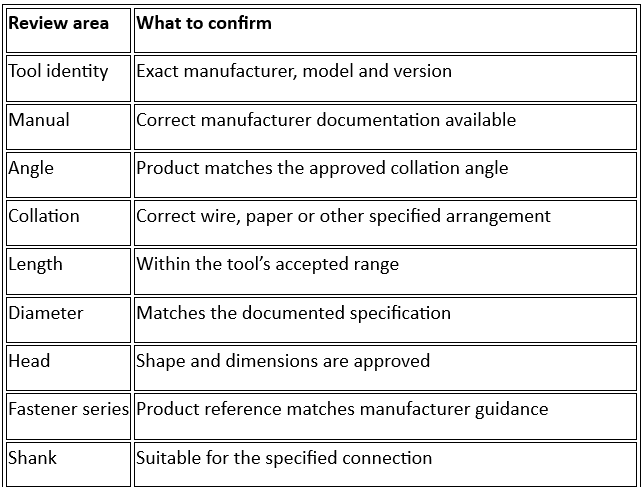
A Practical 28 Degree Framing Nail Compatibility Checklist
Hypothetical Example: Checking Two 75mm Nail Strips
A contractor owns a framing nailer whose manual specifies 28° wire-weld nails within a particular diameter range.
The contractor finds two products advertised as 75mm, 28 degree framing nails.
Although their headline descriptions match, further checking is needed.
Product A Review
- Confirm the wire-weld collation.
• Check the diameter against the manual.
• Verify the head configuration.
• Compare the fastener series.
• Confirm the finish suits the job.
Product B Review
- Identify the collation material.
• Request missing head information.
• Check the actual product code.
• Ask for documented tool compatibility.
• Leave suitability unresolved until the specifications are confirmed.
This example is illustrative. Matching the angle and length does not establish that either product is suitable without reviewing the remaining details.
Common Mistakes to Avoid
Choosing by Angle Alone
Check length, diameter, head configuration and collation as well.
Assuming All 28 Degree Nails Use the Same Collation
Compare the exact product with the tool’s approved fastener system.
Using Another Model’s Specifications
Check the full model number and correct manual for your nailer.
Forcing Nails Into the Magazine
Stop and resolve the mismatch rather than modifying the strip or tool.
Increasing Pressure to Overcome a Compatibility Problem
Keep settings within manufacturer limits and investigate the cause.
Ordering From The Nail Warehouse
The Nail Warehouse lists 28° framing nails in several lengths. Before ordering, provide the information needed to check the exact product against your tool and application. The Nail Warehouse
Before ordering, provide:
- Your nailer manufacturer and model.
• A photograph of the tool identification plate.
• Relevant manual specifications.
• Required nail length and diameter.
• Approved collation type.
• Required head configuration.
• Specified shank profile.
• Timber type and treatment.
• Installation environment.
• Required finish.
• Quantity and delivery location.
Explore The Nail Warehouse product range and confirm the complete specification, availability and delivery arrangements with the team.
Final Thoughts
Choosing 28 degree framing nails means matching the complete fastener specification to your nail gun and the job.
Start with the exact tool model and manual. Check collation, length, diameter and head configuration, then review the shank and finish against the fixing requirements.
Before ordering from The Nail Warehouse, resolve missing specifications and confirm the exact product code. Clear information helps you select the appropriate fastener without relying on angle or length alone.
Explore The Nail Warehouse product range to compare coil nails and related fastening products.
